Read
- The Importance of Strength Training (Michigan State University)
- 11 Benefits of Strength Training That Have Nothing to Do with Muscle Size (U.S. News)

Key Ideas
- Exercise REGRESSION
- Adjusting the demands of an exercise to make it EASIER.
- We can make any given exercise easier by decreasing:
- Load (weight used)
- Range of motion
- Number of repetitions
- Number of sets
- Complexity of exercise
- Going from a 2-leg to a 1-leg squat
- Balance challenge
- Coordination demands
- We can make any given exercise easier by decreasing:
- Adjusting the demands of an exercise to make it EASIER.
- Exercise PROGRESSION
- Adjusting the demands of an exercise to make it HARDER.
- We can make an exercise harder by increasing:
- Load (weight used)
- Range of motion
- Number of repetitions
- Number of sets
- Complexity of exercise
- Going from a 2-leg squat to a 1-leg squat
- Balance challenge
- Coordination demands
- We can make an exercise harder by increasing:
- Adjusting the demands of an exercise to make it HARDER.
- Resistance training exercises generally includes 3 types of muscle contraction during each repetition (ex: bicep curl):

How to Small Changes to Exercises Add Up!
We can make small adjustments to exercises that will create a whole new training stimulus and challenge.
Here are few examples:
100 second ECCENTRIC Push-Up
1 Minute, 1 Rep Bodyweight Chin-Up
Exercise Instruction
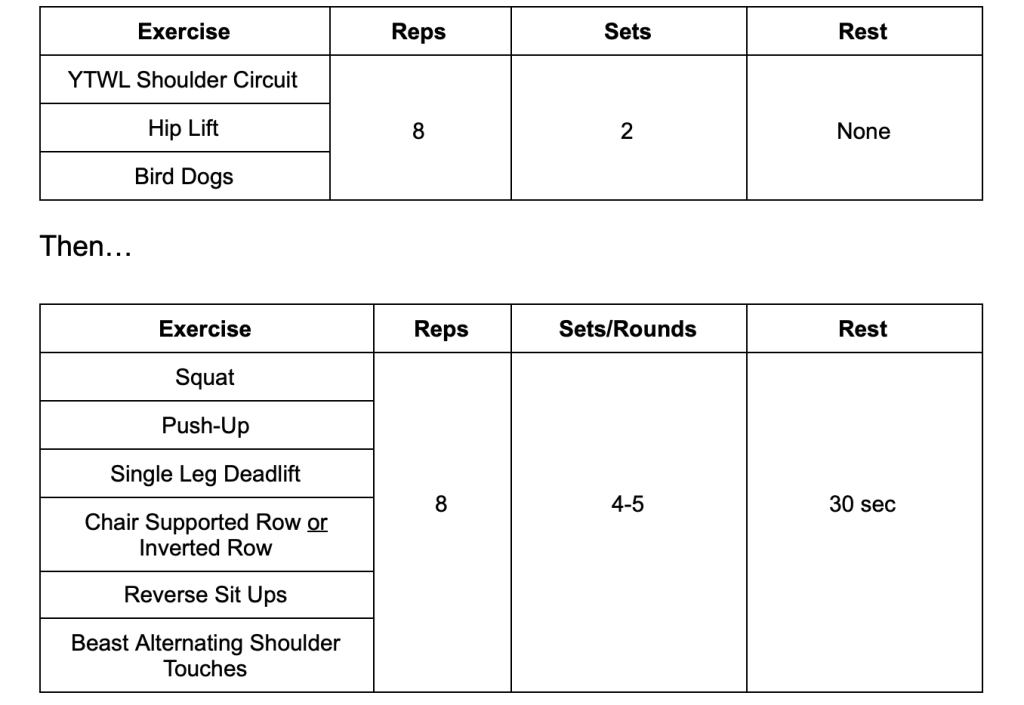
- Regressions/Progressions for:
- Bird Dogs
- High Plank Row
- Hollow Body Progressions
- YTWL Shoulder Circuit
Activity
Let’s use the squat as an example. Squats are a common exercise, to it’ll be perfect to help make my point here:
Here are a few ways the squat exercise can be adjusted:
- Add weight (external load, ex: backpack, barbell, cardboard box)
- Add volume (reps, sets)
- Range of motion (depth of the squat)
- Bilateral to Unilateral
- Bilateral
- Split Squat
- Rear Foot Elevated Split Squat
- Single Leg Squat or Skater Squat Variations
- Increase Time Under Tension (aka: spend more time squatting while squatting)
- Slow down the eccentric
- Slow down concentric
- Isometric (stop motion and hold)
- Change Stance
- Staggered Stance
- Narrow
- Wide
- Elevation (one foot up, one down)
- New surfaces/terrain
- Uneven
- Soft vs. Hard surfaces
- Wobbly
- Combinations
- Moving from one movement into another
- Transitions
- Reaction
Do you see how drastically we can make subtle tweaks to change the demands, stimulus and overall experience?
This is just for a squat. We can make very similar changes to any other exercise.
You DO NOT need to practice change your squat style every time you workout. Focus on building strength, coordination and mechanics with just a few variations at one time.
For example, you might decide that you want to improve squat jump power and single leg strength.
In this situation, train squat jumps and single leg squat variations for strength.
If you’re working on a 4-day per week workout schedule, here’s an example of how you could pursue your goals:
Workout 1: Squat jumps (power)
Workout 2: Unsupported Single leg squat (strength)
Workout 3: Split Squat jumps (power)
Workout 4: Rear Foot Elevated Split Squat (strength)
2 power days and 2 strength days each week.
If I could offer one tip: explore single leg squat variations SOONER.
Training on one-leg while limiting strain on the lower back, challenging stability/balance/coordination, without needing a mountain of weights.
Compared to two leg squats, a single leg squat increases the resistance by roughly 71%.
I’m not hinting that two leg exercises are bad. I’m saying single leg training can deliver HUGE benefits in a very resourceful way, and you can do them anywhere.
Injured? Train the healthy side and get benefits to the injured side! Single leg or single arm exercises performed on the non-injured side deliver performance benefits.
This phenomenon is known as: cross-education effect.

 Home Bodyweight Fitness