Read
- “Why Crawling Fixes Everything” (Ace Fitness)
- “All About Ground Movement” (MovNat)

What is locomotion?
Locomotion can be defined as: movement or the ability to move from one place to the other.
For this course, crawling and other ground based locomotion drills will be explored.
You may recognize several crawling variations, while others will be new.
How to SCALE crawling exercises
First, to “scale” an exercise means we are modifying it to suit your unique fitness level.
A beginner might need a crawling exercise to be “scaled” or modified to be made easier. We could go on to say that making the exercise easier means we are using a “regression”. Remember that word from an earlier module?
Advanced trainees may need to scale a crawling exercise up to challenge their fitness level more.
Crawling exercises can be made EASIER by:
- Starting with static (non-moving) variations
- Decrease muscular demand and joint angles (body position)
- Decreasing crawling time or distance for each work set
- Widening the base of support (hands/feet shoulder width or wider)
You’ll recall in the previous ground based movement module, we start with non-moving variations as an introduction.
This is important.
Starting with non-moving variations, or static, is best for beginners to crawling (not just beginners to fitness).
Crawling can be a humbling experience, and no matter what your current fitness level, consider starting with non-moving exercises to give your body an opportunity to acclimate to the demands.
Non-moving variations allow more time to be spent “sorting out” the challenge (strength, endurance, breathing, etc) and connecting the mind to the body, etc.
Crawling exercises can be made HARDER by:
- Progressing to dynamic (moving) variations
- Increasing the muscular demand and joint angles (body position)
- Increasing crawling time or distance for each work set
- Narrowing the base of support (hands/feet inline with each other)
After practicing non-moving variations, it’s time for dynamic or moving variations.
Once you’re moving from point A to point B, you’re fully engaged in locomotion, or more specifically, crawling.
Change the exercise, Increase the Difficulty
Besides crawling for longer distances, more time or decreasing the base of support, hopping from one crawling pattern to the next (progression) can provide the next physical challenge.
Ranking the difficulty of a crawling exercise is pretty simple. Much of it has to do with the body position and muscular demand of the movement.
In this video, I demonstrate 3 different locomotion patterns: Bear Walk, Beast and Lizard.
Coordination, mechanics and timing are necessary for all of these locomotion patterns, but purely from a muscular demand and joint angle standpoint, the Bear Walk is the easiest while the lizard crawl is the hardest.
Let’s compare the position/angle of my torso and the height of my hips during the Bear Walk and Lizard Crawl.
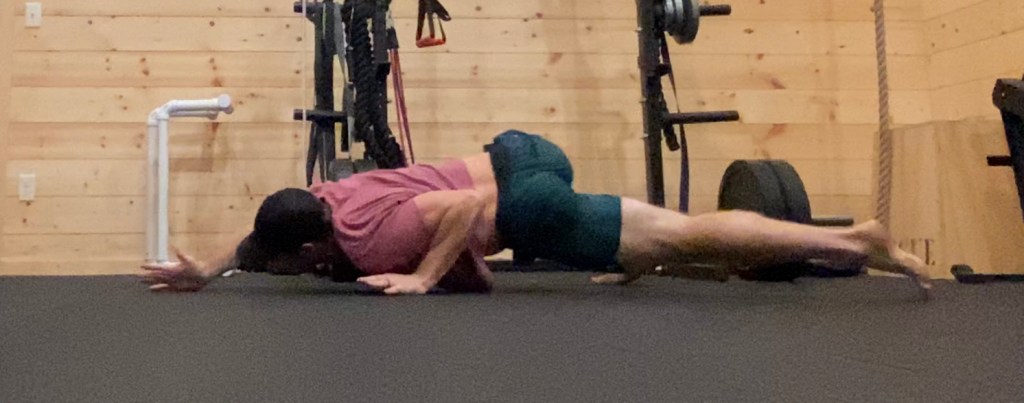
Lizard Crawl 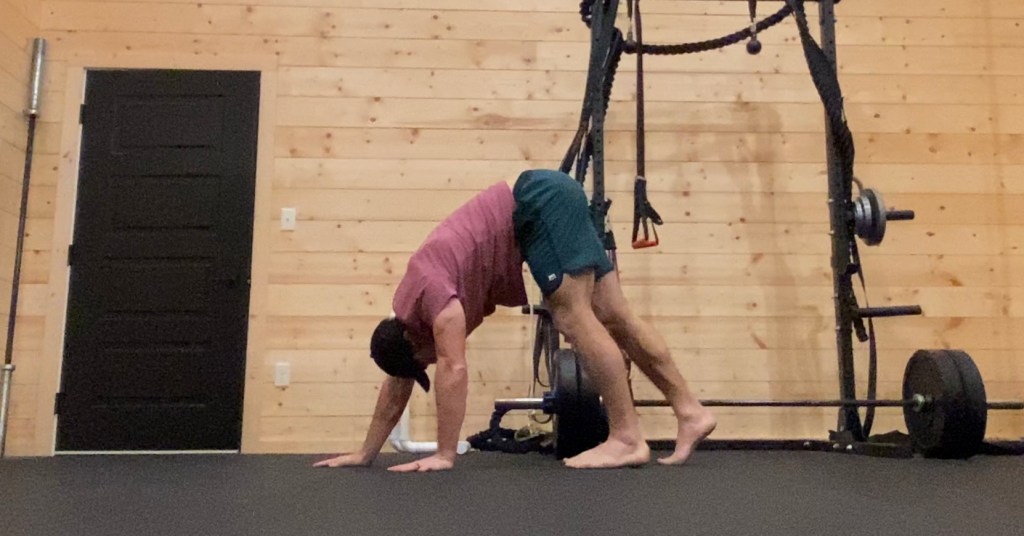
Bear Walk
Staying low to the ground makes a DRAMATIC difference with the muscular effort.
The closer your hips, torso and shoulders are to the floor, the harder crawling exercises become.
Being extremely low to the floor increases the intensity and muscular demand of these exercises tremendously.
For an added challenge to any bodyweight crawling exercises:
- Crawl uphill or downhill
- Vary the direction (forward, backward, lateral, angled)
- Increase the distance or time
- Change levels and positions during a work set (go from Alligator to Beast to Lizard, and back up)
To increase the intensity of these exercises beyond bodyweight:
- Add weight (using a weight vest, plate, etc)
- Perform other movements in combination with the crawling (dragging, pulling, various forms of carrying or pushing)
Exercise Instruction
- Forward/Backward Crawl
- Lateral (side to side) Crawl
- Crab Walk
- Bear Walk
- Crab Reach
- Forward Traveling Ape
- Lateral Traveling Ape
- Rolling Patterns
- Upper Body
- Lower Body
- Lizard Crawl (advanced)
Activity
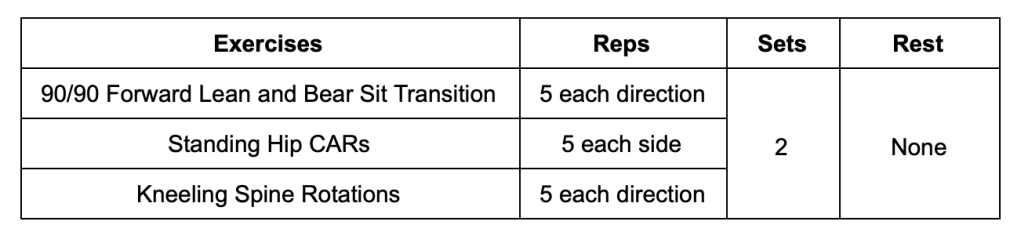
2. Workout
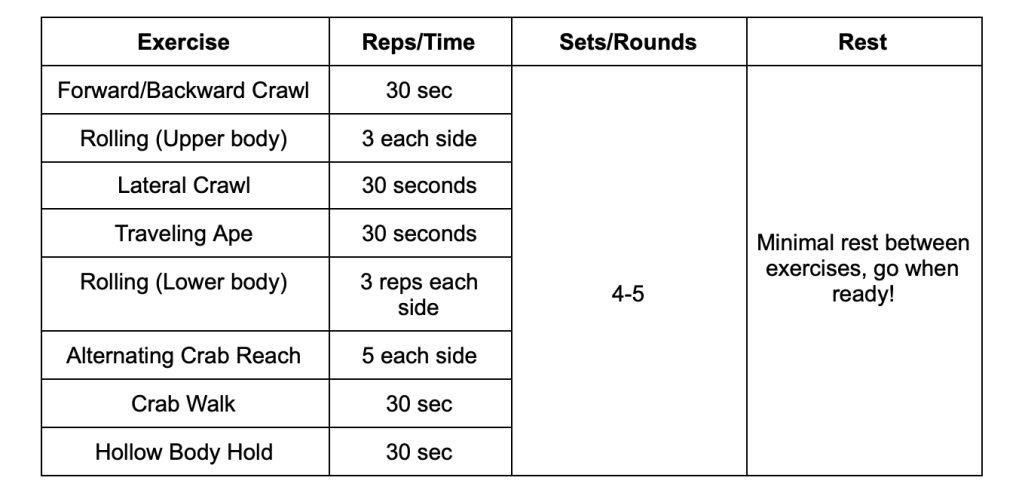

 Home Bodyweight Fitness