Movement Flow, Discipline, Power Words of Fitness, Equipment Overview – (Day 7/ Week 3)

Read

Movement Flow

What is Movement Flow?

Combining exercises in the most fluid way possible, allowing for a smooth transition from one to the next.

Power Words of Fitness

Habits

An acquired mode of behavior that has become nearly or completely involuntary.  Your operating system, guiding you day to day.  

Consistency

Consistency leads to habits. Habits form the actions we take every day. Action leads to success. Keep showing up.  

Discipline 

Self-control.  Getting the job done, even when you may not feel like.  Avoiding temptation, laziness, complacency.  

Effort

A vigorous or determined attempt.  Each workout needs your focus, regardless of the intensity.  

Experience

The fact or state of having been affected by or gained knowledge through direct observation or participation.  The more you practice fitness, the better you’ll get. 

Explore

Try something new, keep an open mind.  Discard what is not useful, keep the rest.  

Sustainability

Fitness is all about making your regimen sustainable, for the long-term.  Partake in activities that get you the results you desire, but also make you want to come back for more.  

Courage

Mental or moral strength to venture, persevere, and withstand danger, fear, or difficulty.  Don’t be afraid, go after your goals. 

Equipment Overview

Adding a few pieces of equipment to a home gym can create a whole new dimension of training opportunities and continue to enhance workout effectiveness.  

Here are a few great options for the home setting:


Carpet Slides

Inexpensive solution to perform lunges, push ups, anti-extension core work, and crawling variations.  They work great on carpeted floors. 

Jump Rope

A time tested method for building cardio without having to move across distances.  You can stay stationary and get a great workout.  Great for building rhythm, timing and coordination.  

Doorway Chin Up Bar

Simple solution that’ll give you the chance to practice upper body pulling exercises and drills that involve hanging.  This device wedges itself on both sides of most door frames and can tolerate a large amount of weight.  Vertical pulling exercises tend to be absent from most pure bodyweight programs, so adding this to a home gym is a game changer.  

Suspension Trainer (or Gymnastics Rings)

By far, a suspension trainer is the most versatile and packable piece of equipment on this list.  There are hundreds of exercises that can be performed using a suspension trainer anchored to a door or overhead bar.  Suspension trainers work by leveraging gravity, bodyweight and angles to provide varied levels of resistance to exercises.  

Resistance Bands

Rubber resistance bands offer variable resistance to exercises, and are extremely packable when traveling.  

Sandbag

Sandbags simulate real world resistance training.  The sandbag is constantly changing shape, slippery to hold and lacks structure.  Most sandbags come with handles on the outside of the bag, which allows for traditional exercises to be executed (deadlifts, lunges, carrying variations, squats, pressing and pulling).  Sandbags are one of my favorite pieces of gym equipment because of their unique structure and shape.  The ability to bearhug, shoulder, drag and perform open hand exercises creates a whole new world of strength training.

Kettlebells 

Kettlebells are a “cannonball” with a handle on top.  This cannonball sits below the handles, which creates an opportunity to use kettlebells for unique exercises like swings, cleans, snatches, combination movements, overhead pressing, pulling, various horizontal pressing, carrying, etc.  Kettlebells are rank supreme from a durability standpoint.  They’re virtually bulletproof, which means the investment will still be getting good use 10-15 years down the road.  

Dumbbells 

One of the most recognizable pieces of gym equipment on the planet, dumbbells add weight in a balanced fashion (symmetric weight on either side of the handle).  Companies like Powerblock and Bowflex (among others) have created compact, space efficient adjustable dumbbells that are affordable and PERFECT for the home gym setting.

Barbell and Plates

A barbell and plates offers a time tested way to add weight to exercises like deadlifts, squats, overhead pressing, horizontal pressing, rows, lunges, etc.  Barbells can also be combined with a landmine trainer to create a new dimension of exercises (angled pressing, rotation training, etc).  The biggest issue with a barbell and plate set up is space and concern over damaging the floor you’re training on. 

Watch

“Everything you’ve ever wanted in life is on the other side of hard work.” Tim Kennedy

Activity

  • Workout

Unilateral Training and Hybrid Workout #4 – (Week 7/ Day 2)

Read

What is Unilateral Training?

Single arm or single leg movements/exercises. 

Benefits of Unilateral Training

  • Using both sides of the body equally.
  • Helps isolate and correct muscle imbalances.
  • Avoid overusing or overtraining the dominant side.
  • Improves balance.
  • Automatic core training since the core acts as a stabilizer during movements.
  • Cross Education Effect for rehabilitating injuries 
    • Training one side of the body stimulates the other side.
    • Indirect stimulation of the non-working side of the body via working the opposite side improves strength in the injured area. 
  • Lower-back friendly.
  • Resourceful way to improve strength.

Unilateral Exercise Examples

  • Single Leg Balance Squats
  • Skater Squats
  • Carpet Slide Reverse Lunges
  • Step Ups
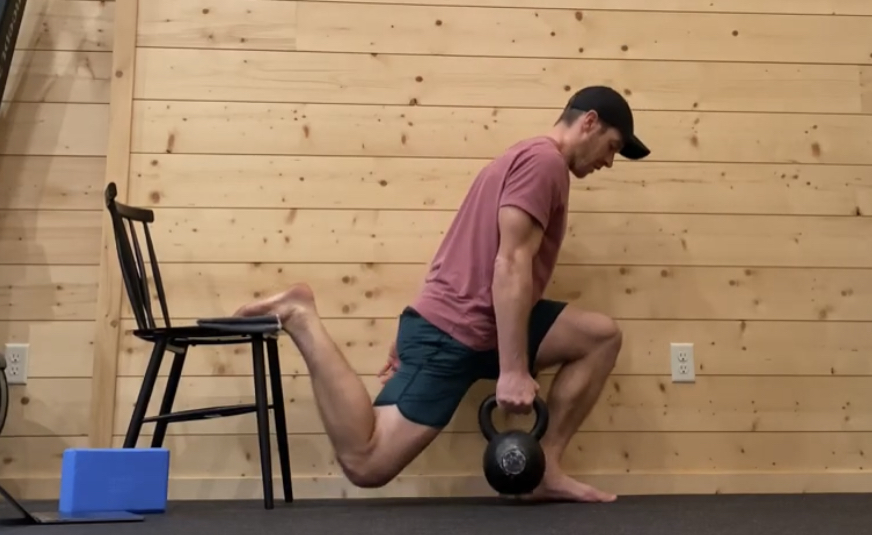
  • Rear Foot Elevated Split Squats
  • Lunges (reverse, forward, lateral)
  • Carpet Slide Push Ups
  • Single Arm Rows 
  • One Arm Chin Ups
  • Single Arm Overhead Press

Watch

Activity

  • Workout Finisher
    • Complete as many rounds as possible in 5 minutes of:
      • 3 Lateral Push Ups
      • 3 Alternating Split Squats
      • 3 Side Kick Throughs

Workout Finishers, Filler Exercises and Burpees (Week 6/ Day 1)

Read

3 Simple Ways to Make Exercise a Habit (James Clear)

Burpees: Are they a good or bad exercise?

Workout Finisher

  • During a workout finisher, you work at near-maximum intensity for 2–10 minutes and utilize a combination of strength and cardio exercises.
  • Examples:
    • 10 burpees at the top of every minute for 10 minutes.
    • 5 push ups + 5 alternating split squat jumps without rest for 8 minutes
    • Complete as many rounds as possible in 10 minutes of:
      • 10 squat jumps 
      • 10 inverted rows 
      • 10 sit-ups 
      • 10 jumping jacks

Filler Exercises

  • A “filler” exercise is any movement or drill paired with a strength exercise as part of an active rest period
  • Instead of sitting down and checking your phone while waiting for the next set, you perform another low-impact exercise to improve mobility, activation, stability or positioning during a lift.
  • Core exercises, mobility drills and exercises with low muscular demand (jumping jacks) make good filler exercises.

Watch

Habits are EVERYTHING when it comes to sticking to fitness. James Clear is an amazing writer, and does an excellent job dissecting habit formation.

Activity

Floor Exercises and More – (Week 5/ Day 3)

Read

Watch

Exercise Instruction

Just as a heads up, WE ARE NOT going to be using all of the following exercises in today’s workout, so don’t be alarmed.

I am sharing these movements so that you know they exist. Each carries it’s own value, and when plugged into a workout regimen, delivers benefit.

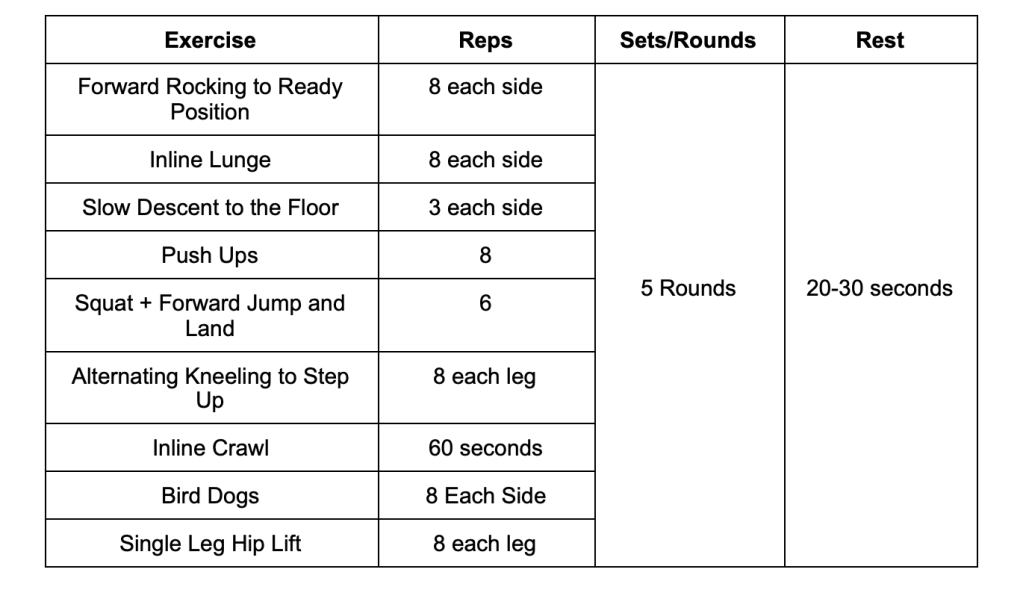
The workout is listed below.

And More! 😉

Activity

Turkish Get Ups Part 2 – (Week 5/ Day 2)

Read

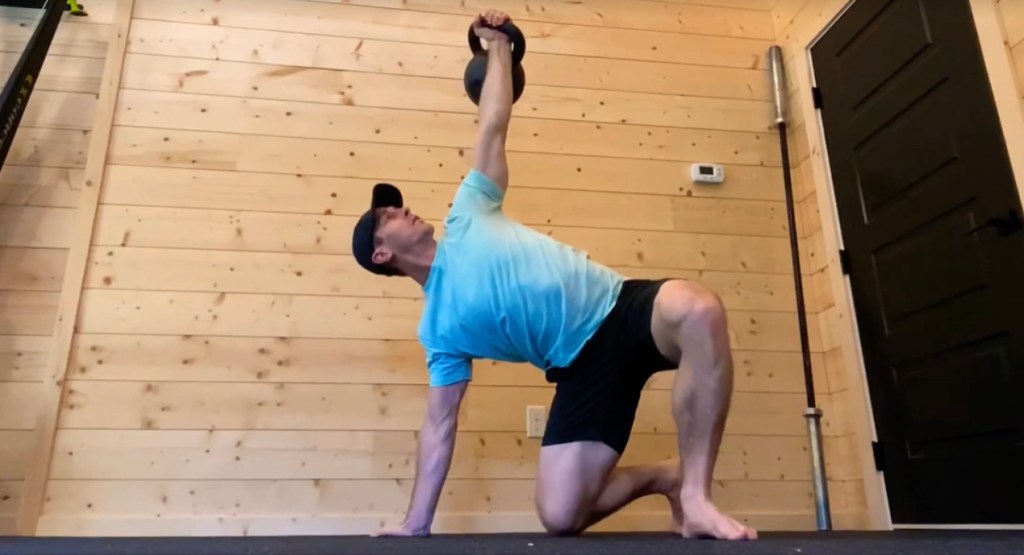
The “Swiss Army knife” exercise

The original Turkish Get Ups exericse incredible as is.

But, why not explore adding other exercises into the original variation?

Doing so will bring a fresh training experience to the original Turkish Get Up, challenge the body and boost the training stimulus.

Here are few exercises we can add:

  • Rows
  • Squats
  • Overhead pressing
  • Carrying
  • Horizontal pressing
  • Lunges
  • Power exercises (clean, snatch swing)

Upper body pulling is a movement pattern the Turkish Get Up lacks.

Adding in a few repetitions of rows once you’re in the standing position can check ✔️ that box.

Turkish Get Ups are an exercise that can truly do it all.

Watch

Activity

Turkish Get Ups Part 1 -(Week 5/ Day 1)

Read

Benefits of Turkish Get Ups

  1. Promotes cross lateralization (getting the right brain to work with the left side)
  2. Promotes upper body stability
  3. Promotes lower body stability
  4. Promotes reflexive stability of the trunk and extremities
  5. Ties the right arm to the left leg, and left arm to the right leg
  6. Gets the upper extremities working reciprocally (legs, too)
  7. Stimulates the vestibular system (one of three senses that contributes to balance)
  8. Stimulates the visual system (second of three senses that contributes to balance)
  9. Stimulates the proprioception system (a third sense that contributes to balance)
  10. Promotes spatial awareness
  11. Develops a front/back weight shift
  12. Develops upper body strength, trunks strength, and hip strength

(From 👉 “The Forgotten Benefits of the Get-Up”, StrongFirst.com)

Introduction to Turkish Get Ups

Exercise Instruction

Activity

  • Workout
    • 10 Minutes of Turkish Get Ups
      • 2 different options below
      • Non-stop movement (minimal rest)
      • Alternating right and left side each rep
      • Good technique! Keep moving!

Option 1: Shoe Turkish Get Ups (beginner)

or

Option 2: Backpack Loaded Turkish Get Ups (intermediate/advanced)

Natural Movement – (Week 4/ Day 3)

Read

  1. “Natural Movement, Going Back to Basics” (Mayo Clinic)
  2. “All About Ground Movement” (MovNat)

Exercise Instruction

Activity