Ground Based Movement – Dynamic/Locomotion Drills – (Week 4/ Day 1)

Read

  1. “Why Crawling Fixes Everything” (Ace Fitness)
  2. “All About Ground Movement” (MovNat)
Crawling

What is locomotion?

Locomotion can be defined as: movement or the ability to move from one place to the other.

For this course, crawling and other ground based locomotion drills will be explored.

You may recognize several crawling variations, while others will be new.

How to SCALE crawling exercises

First, to “scale” an exercise means we are modifying it to suit your unique fitness level.

A beginner might need a crawling exercise to be “scaled” or modified to be made easier. We could go on to say that making the exercise easier means we are using a “regression”. Remember that word from an earlier module?

Advanced trainees may need to scale a crawling exercise up to challenge their fitness level more.

Crawling exercises can be made EASIER by:

  • Starting with static (non-moving) variations
  • Decrease muscular demand and joint angles (body position)
  • Decreasing crawling time or distance for each work set
  • Widening the base of support (hands/feet shoulder width or wider)

You’ll recall in the previous ground based movement module, we start with non-moving variations as an introduction.

This is important.

Starting with non-moving variations, or static, is best for beginners to crawling (not just beginners to fitness).

Crawling can be a humbling experience, and no matter what your current fitness level, consider starting with non-moving exercises to give your body an opportunity to acclimate to the demands.

Non-moving variations allow more time to be spent “sorting out” the challenge (strength, endurance, breathing, etc) and connecting the mind to the body, etc.

Crawling exercises can be made HARDER by:

  • Progressing to dynamic (moving) variations
  • Increasing the muscular demand and joint angles (body position)
  • Increasing crawling time or distance for each work set
  • Narrowing the base of support (hands/feet inline with each other)

After practicing non-moving variations, it’s time for dynamic or moving variations.

Once you’re moving from point A to point B, you’re fully engaged in locomotion, or more specifically, crawling.

Change the exercise, Increase the Difficulty

Besides crawling for longer distances, more time or decreasing the base of support, hopping from one crawling pattern to the next (progression) can provide the next physical challenge.

Ranking the difficulty of a crawling exercise is pretty simple. Much of it has to do with the body position and muscular demand of the movement.

In this video, I demonstrate 3 different locomotion patterns: Bear Walk, Beast and Lizard.

Coordination, mechanics and timing are necessary for all of these locomotion patterns, but purely from a muscular demand and joint angle standpoint, the Bear Walk is the easiest while the lizard crawl is the hardest.

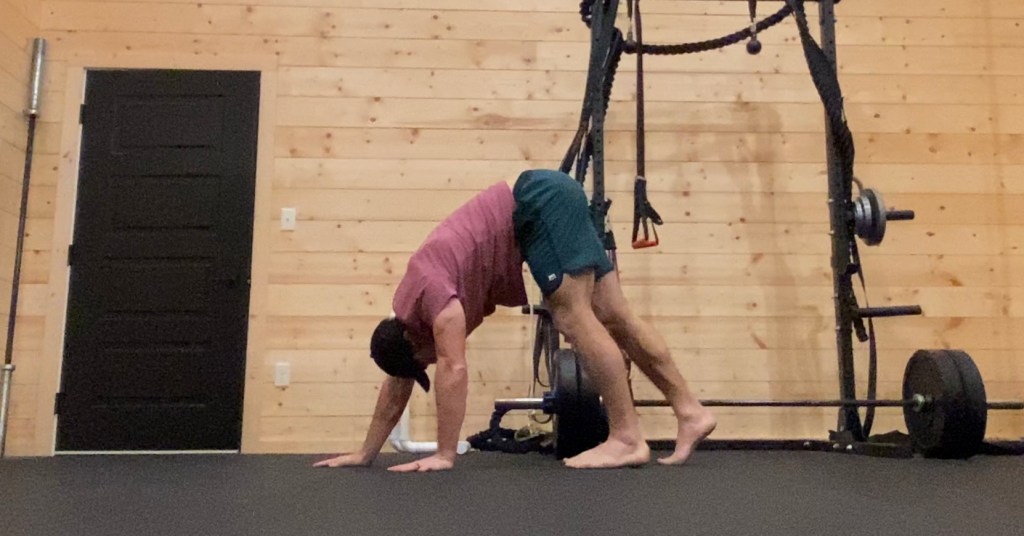
Let’s compare the position/angle of my torso and the height of my hips during the Bear Walk and Lizard Crawl.
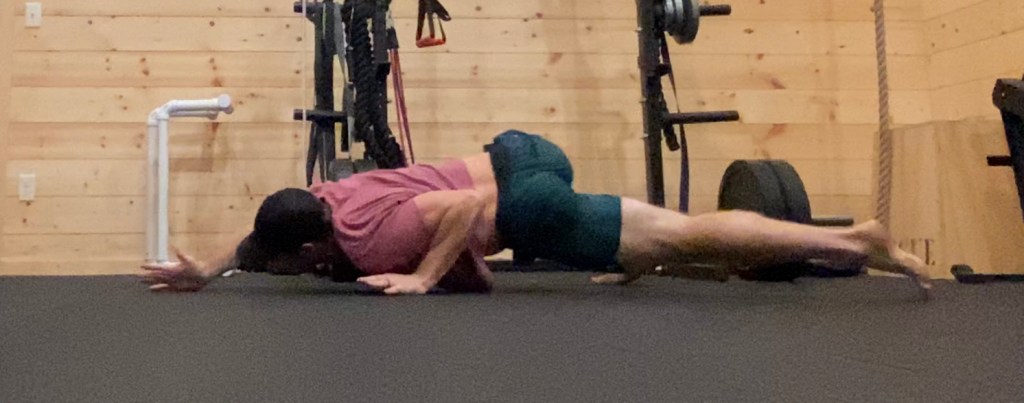
Staying low to the ground makes a DRAMATIC difference with the muscular effort.

The closer your hips, torso and shoulders are to the floor, the harder crawling exercises become.

Being extremely low to the floor increases the intensity and muscular demand of these exercises tremendously.

For an added challenge to any bodyweight crawling exercises:

  • Crawl uphill or downhill
  • Vary the direction (forward, backward, lateral, angled)
  • Increase the distance or time
  • Change levels and positions during a work set (go from Alligator to Beast to Lizard, and back up)

To increase the intensity of these exercises beyond bodyweight:

  • Add weight (using a weight vest, plate, etc)
  • Perform other movements in combination with the crawling (dragging, pulling, various forms of carrying or pushing)

Exercise Instruction

Activity

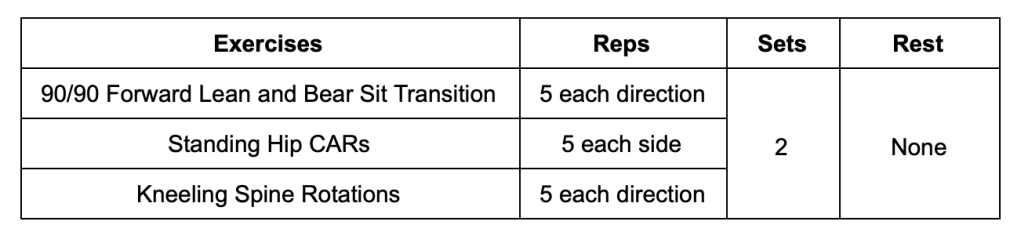
  1. Mobility

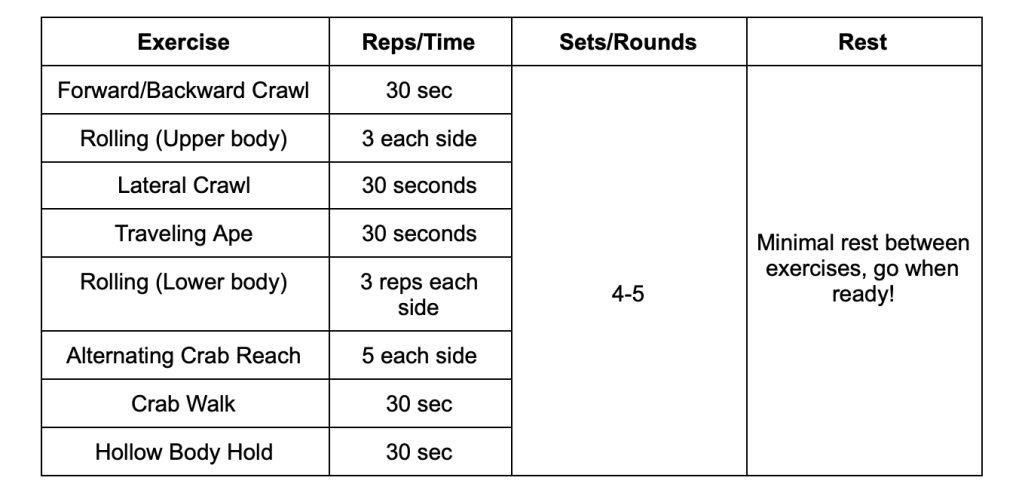
2. Workout

Ground Based Movement – Sequences (Week 4/ Day 2)

Read

Ground based movement SEQUENCES combine 2-4 exercises to create a pre-planned series of movement.

You know what’s coming next in the sequence, and your objective is to refine the technique of each movement while doing your best to create SMOOTH and confident transitions

Ground based movement sequences are challenging (yet highly beneficial) because you’re moving your body in and out of several planes of motion in every sequence.

Your body is constantly taking in information, navigating body positions, re-calibrating, adjusting on the fly.

This type of free flowing exercise is a big MISSING ELEMENT with most workout regimens.

Exercise Instruction

Activity

  • Workout

Mobility Training Part 1 – (Week 3/Day 1)

Read

  • Passive range of motion (left above)
    • Person moves joint while completely relaxed, there is outside force or assistance in doing this.   
  • Active range of motion (right above)
    • No help in moving a joint, all movement is performed by the person.

Watch

Exercise Instruction

Activity

Core Training – (Week 2/ Day 3)

Read

Watch

Core Functions and Movements

  • Flexion/Extension
  • Lateral Flexion
  • Rotation

Anti-training 

“Anti” means resistance motion or forces acting the body.

Anti-Rotation include the Pallof Press:

Anti-Lateral Flexion includes uni-lateral farmer carry:

Anti-Extension includes Ab Wheel Roll Outs:

More Core Exercises

Activity

  1. Warm Up
  1. Workout

Movement Patterns Part 2 (Week 2/ Day 2)

Read

Key Ideas

  • Exercise REGRESSION
    • Adjusting the demands of an exercise to make it EASIER.
      • We can make any given exercise easier by decreasing:
        • Load (weight used)
        • Range of motion 
        • Number of repetitions
        • Number of sets
        • Complexity of exercise 
          • Going from a 2-leg to a 1-leg squat
          • Balance challenge
          • Coordination demands
  • Exercise PROGRESSION
    • Adjusting the demands of an exercise to make it HARDER.
      • We can make an exercise harder by increasing:
        • Load (weight used)
        • Range of motion
        • Number of repetitions
        • Number of sets
        • Complexity of exercise
          • Going from a 2-leg squat to a 1-leg squat
          • Balance challenge
          • Coordination demands
  • Resistance training exercises generally includes 3 types of muscle contraction during each repetition (ex: bicep curl):

How to Small Changes to Exercises Add Up!

We can make small adjustments to exercises that will create a whole new training stimulus and challenge.

Here are few examples:

100 second ECCENTRIC Push-Up

1 Minute, 1 Rep Bodyweight Chin-Up

Exercise Instruction

Activity

  1. Warm Up
  1. Activation and Workout

Let’s use the squat as an example. Squats are a common exercise, to it’ll be perfect to help make my point here:

Here are a few ways the squat exercise can be adjusted:

  • Add weight (external load, ex: backpack, barbell, cardboard box)
  • Add volume (reps, sets)
  • Range of motion (depth of the squat)
  • Bilateral to Unilateral
    • Bilateral
    • Split Squat
    • Rear Foot Elevated Split Squat
    • Single Leg Squat or Skater Squat Variations
  • Increase Time Under Tension (aka:  spend more time squatting while squatting)
    • Slow down the eccentric
    • Slow down concentric
    • Isometric (stop motion and hold)
  • Change Stance
    • Staggered Stance
    • Narrow
    • Wide
    • Elevation (one foot up, one down)
  • New surfaces/terrain
    • Uneven
    • Soft vs. Hard surfaces
    • Wobbly
  • Combinations 
    • Moving from one movement into another
    • Transitions
    • Reaction

Do you see how drastically we can make subtle tweaks to change the demands, stimulus and overall experience?  

This is just for a squat.  We can make very similar changes to any other exercise.  

You DO NOT need to practice change your squat style every time you workout.  Focus on building strength, coordination and mechanics with just a few variations at one time.  

For example, you might decide that you want to improve squat jump power and single leg strength.  

In this situation, train squat jumps and single leg squat variations for strength. 

If you’re working on a 4-day per week workout schedule, here’s an example of how you could pursue your goals: 

Workout  1:  Squat jumps (power)

Workout  2:  Unsupported Single leg squat (strength)

Workout  3:  Split Squat jumps (power)

Workout  4:  Rear Foot Elevated Split Squat (strength)

2 power days and 2 strength days each week. 

If I could offer one tip:  explore single leg squat variations SOONER.  

Training on one-leg while limiting strain on the lower back, challenging stability/balance/coordination, without needing a mountain of weights.  

Compared to two leg squats, a single leg squat increases the resistance by roughly 71%.  

I’m not hinting that two leg exercises are bad.  I’m saying single leg training can deliver HUGE benefits in a very resourceful way, and you can do them anywhere.  

Injured?  Train the healthy side and get benefits to the injured side!  Single leg or single arm exercises performed on the non-injured side deliver performance benefits.  

This phenomenon is known as:  cross-education effect.  

Movement Patterns Part 1 – (Week 2/ Day 1)

Read

  • What is repetition?
    • One completion of an exercise (example:  1 rep of a push up)
  • What is a set?  
    • A completed number of exercises of repetition in a work interval. 
    • 8 reps of push-ups = 1 set.
  • What are rest periods during a workout?
    • Time in between each set of exercise
    • Allow for muscles to recover from the stress of the set/reps/weight. 
  • What is a rest day?  Why are rest days important?

Exercise Instruction

Activity

  1. Warm Up

2. Movement Pattern Workout

Workout Design (Week 1/ Day 2)

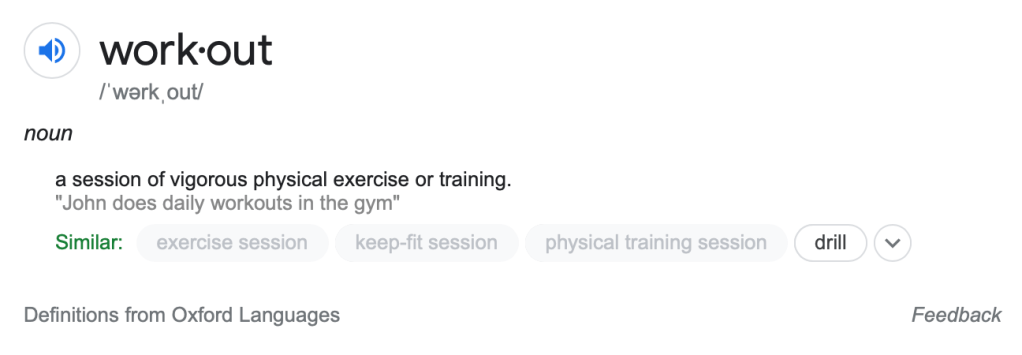
A workout is intentional, vigorous, pre-planned exercise generally taking place in a controlled environment.

There are a lot of different activities that can be performed as a workout, but here is a short list of some of the more popular and effective options for improving performance, aesthetics and maintaining health.

Exercise Options

  • Resistance Training 
  • Cardio Conditioning
  • Ground-Based or Natural Movement 
  • Mobility
  • Flexibility

👉 For clarification, resistance training can be moving your body against gravity or moving/lifting external weight.

This course is focused on bodyweight fitness, so let’s look at a really simple way to organize a complete workout.

Daily Workout Template:

If you had 60 minutes for a workout, it could look something like this:

Step 1:  Warm-Up (10 minutes)

Step 2:  Bodyweight Resistance Training (30 minutes)

Step 3:  Cardio or Workout Finisher/Mobility/Flexibility (15-20 minutes)

With this format, you can accomplish A LOT OF WORK in a reasonable amount of time.

Finding 60 minutes for a workout is not always going to be possible.

Life gets in the way. Studying gets in the way. Work gets in the way. There are a lot of things throughout each day that suck up our time.

My advice to you is this: protect your workout time and make it sacred.

Mark it a priority, a non-negotiable.

However many days you choose to partake in a dedicated workout, fight for that time.

Fitness is a lot like investing. The earlier you start, the better things tend to be later in life. This is not implying you’re guaranteed to live longer or anything like that (though you might 🤔), but might be closer related with adopting the good habits associated with exercise and being regimented.

Imperfect Workout Time

This is almost an oxymoron for me, because if you get into workout mode even though you’re extremely tight on time, I applaud you for doing it anyways.

And you should.

Fact: Some days just aren’t going to allow for the ideal workout.

Again, life gets in the way.

But, if you get a free 20 minutes, you could:

  1. Warm up (5 minutes)
  2. Workout (15 minutes)

The workout could include: push ups, squat, lunges, a pulling exercise and a core exercise. Cycle through each exercise until you’re out of time.

Boom.

You just checked ✔️ an important movement box for the day.

Now, just think. If you can make adjustments to work with a 20 minute window of free time, 30+ minutes is a cakewalk. 40 minutes, a non-issue. 50+ minutes? Breeze.

Be a solutionist with exercise.

Refocus your eyes on what you do have, not what you don’t have. Looking at it this way, opportunities arise, regardless of how imperfect it might be.

Imperfect Training Spaces and Equipment

Bodyweight training is amazing for tiny, cramped spaces.

I took the opportunity to shoot a workout video from the comfort of my bathroom floor just to make my point.

It’s amazing how much progress you can make in a living room or bedroom.

Chairs, floors, coffee tables, kitchen counters, couches and a backpack loaded up with textbooks suddenly become effective workout equipment.

Most of my workout videos were filmed with you guys in mind.

NEAT

NEAT stands for: Non-exercise activity thermogenesis.

NEAT is the energy expended for anything you do that is not eating, sleeping or exercise.

Again, just to be clear, a workout is NOT part of NEAT.

It’s ESSENTIAL to have plenty of NEAT in your life.

Walking is an amazing way to ramp up your NEAT throughout the day, week, month and year.

Here’s an amazing article on THE POWER OF WALKING.

Lastly, here’s an interesting article on the calorie burn related to walking.

Activity

No workout today.

In the next module we will begin the physical activity section of this course.

  • Today’s activity is more of a CHALLENGE for the remainder of this course and beyond 👇👇👇
  • Accumulate 10,000 steps per day

How to Warm Up Before a Workout (Week 1, Day 3)

The fundamental goal of a warm-up is to prepare your body for the more intense exercise that lies ahead.

A warm up generally consists of an assortment of dynamic stretches, movements, mobility drills and occasionally an activity that will increase your heart rate (jogging, biking, jumping rope, etc).


Benefits of Warming Up 

  • Increased flexibility. Being more flexible can make it easier to move and exercise correctly.
  • Lower risk of injury. Warming up your muscles can help them relax which, in turn, can lead to less injury.
  • Increased blood flow and oxygen. Having more blood flow helps your muscles get the nourishment they need before launching into more intense work.
  • Improved performance. Studies show that warmed up muscles can help you work out more effectively.
  • Better range of motion. Having greater range of motion can help you move your joints more fully. 
  • Less muscle tension and pain. Muscles that are warm and relaxed may help you move more easily and with less pain or stiffness.

(Article Source:  Healthline)

Warm ups do not need to be long.

Keep it brief, focused and rich with movement.

10-15 minutes is a nice amount of time to work through a total body warm up.

If you are pressed for time, EXPRESS warm-ups can be used.

5 minutes of light jogging, biking, jumping rope or lower intensity bodyweight exercise can serve to increase heart rate and core temperature enough to transition into vigorous exercise.

NOTE: Express style warm ups are not my #1 choice, but being practical when TIME is limited can be a nice option.

Again, remember that time is a big limitation for people to stick to fitness. If trimming a few minutes off the warm up is what get’s the workout in for the day, DO IT!

Otherwise, opt for a complete warm up prior to most workouts.

Use the Warm Up to Make Progress

People often overlook the value of the warm up period.

They’ll skip warm ups or lazily go through the motions.

I encourage you to use warm up time to make progress toward fitness goals.

Warm ups should challenge your mind and body.

Balance, stability, mobility, coordination, flexibility, etc.

The stretches, dynamic movements, mobility exercises and other drills will contribute to improving your overall fitness.

You’re preparing your body (muscles, heart and mind) for more intense physical work ahead, but you can also use the warm up period to

Barefoot Warm Up

No shoes during the warm up, please.

Especially if you’re at home. Go barefoot, I demand it! 😉

If you’re performing these workouts in a public gym, check with the staff if you can train barefoot.

A lot of public gyms have policies against this.

If barefoot is not an option, try your best to warm up in socks only.

Foot performance is CRUCIAL.

The feet are one of, it not THEE most overlooked part of the body in fitness.

Yet, we desperately need our feet healthy, resilient and capable of performing for life.

Going barefoot during warm ups and workouts allows us an opportunity to stress and strengthen the feet, just as we do with other body parts.

If possible, I want you to participate in this course WITHOUT shoes.

Too Sore to Workout? Warm Up…

If your body is sore from a previous workout, work your way through a warm up.

Sooooooooo many times I’ve felt brutal soreness from one workout going into the next, that was dramatically reduced by a warm up using full range of motion exercises.

Once you get the blood flow, joints moving and muscles re-engaged into lower intensity exercises, you’ll be surprised by how different your body feels and the shift in your mindset.

Almost any new exercise stimulus is going to create soreness, known as DOMS.

DOMS = delayed onset muscle soreness.

If you push yourself hard in a workout on Monday using new exercises/movements, you’re highly likely to experience soreness on Tuesday and Wednesday.

Soreness is part of fitness, and physical activity in general.

The quality of a workout should NEVER be judged based on how sore you are the next day.

People love to chase soreness and relate it to “getting a good workout”.

Fitness is a long-game. We want to deliver a good stimulus from each workout to create positive changes, but do our best to avoid sidelining you from wanting to move in the days after.

Soreness is mainly an indication you did something NEW, nothing else. The result is sore muscles.

Gross but true… if you’ve had the flu and spent some time puking, you likely felt soreness in your stomach muscles (and elsewhere). Does that mean you had a good workout? 😉

Warm Up Exercise Instruction

Activity

Warm-Up (19 minutes)